Dicevaders Guide: Master Alien Invasions with Tactical Dice
Discover how to dominate in Dicevaders, the latest dice-based roguelike deckbuilder. Get expert tips on managing commanders, synergies, and grid tactics.
Published: Dicevaders Wiki Editorial Team
Table of Contents
Master the Art of the Invasion
If you have ever wanted to flip the script on typical space-faring heroes, Dicevaders is your chance to command the alien front. Developed by Pengonauts, this turn-based roguelike deckbuilder forces you to rethink your strategy by trading traditional cards for high-stakes dice manipulation. Whether you are a fan of grid-based tactics or looking for the next big addiction in the roguelite genre, understanding the core mechanics of this title is the key to dominating the battlefield.
In this guide, we dive deep into the mechanics of Dicevaders, exploring how to leverage your commanders, manage resources, and break the game’s systems to reach the highest scores. Strategy is not just about luck; it is about how you manipulate the odds to turn a standard run into an unstoppable chain reaction of destruction.
Understanding the Core Loop: How Dicevaders Works
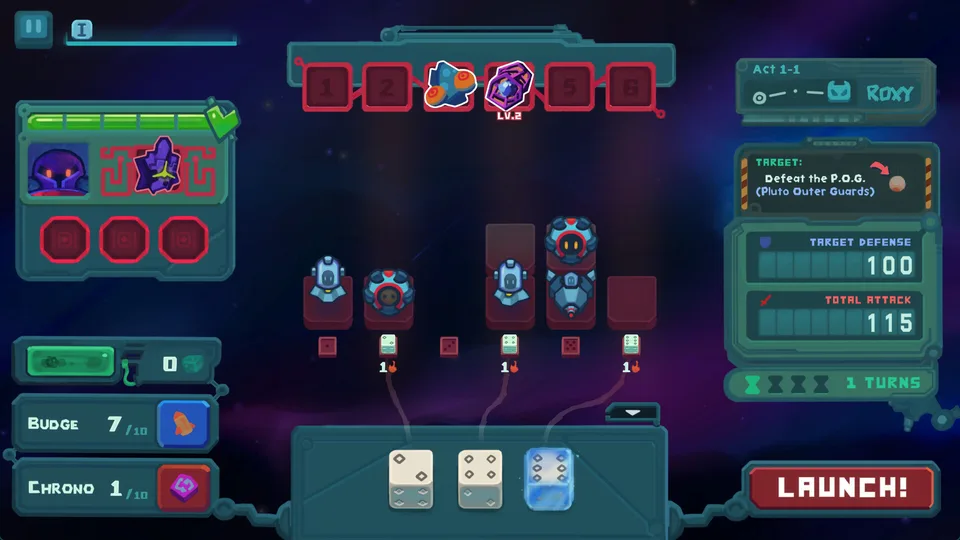
Unlike traditional deckbuilders where cards act as your primary resource, Dicevaders uses a dice-row system. You occupy a six-column grid, placing units to maximize your total attack score within four turns. Your objective is to surpass the enemy’s Target Defense while managing your health points, which act as your primary survival metric.
The Mechanics of Tactical Manipulation
Mechanic
Function
Strategic Purpose
Chrono
Reroll dice/shop
Optimize hand quality
Budge
Adjust die values
Trigger specific column effects
Multipliers
Score boosting
Exponential damage growth
Units
Grid placement
Establish board presence
The game rewards those who look ahead. Because you can see the requirements for the next battle, managing your "Chrono" usage is vital. Don't waste your rerolls in the early game; save them for when you need to force a specific synergy or find a crucial unit to complete your grid formation.
Choosing Your Commander: Playstyles and Synergies
Each commander in the game offers a unique way to approach the invasion. Currently, the game features a variety of commanders, each with distinct perks and XP scaling paths. According to community reports, players often find that matching your commander to your preferred playstyle is the most critical decision at the start of a run.
Popular Commander Archetypes
Commander
Primary Playstyle
Key Advantage
Standard
Balanced / Versatile
Predictable scaling
Blob Girl
High Risk / High Reward
Access to mini-dice and health-cost units
Overseer
Synergy-focused
Merges multiple playstyles
Blob Girl, for example, is a favorite among advanced players. By sacrificing health to deploy powerful units, you can generate mini-dice that roll automatically. This creates a massive scoring potential, provided you can keep your health pool above zero. Always check the commander’s perk list before starting; some synergies are game-breaking if combined with the right artifacts.
Advanced Tactics: Breaking the Game
To truly excel at Dicevaders, you must move beyond the basics of adding numbers. The game is designed to be "broken" if you find the right combinations. The most successful runs usually involve layering multipliers in the slots above your six grid columns.
Step-by-Step Strategy for High Scores
Prioritize Multipliers: Early game gold should almost always go toward scaling multipliers rather than new units.
Align Your Pairs: Focus on building triples or quadruples. These combinations often trigger unique, high-damage automated battles.
Watch the Pilots: Remember, the bosses are the pilots from the StarVaders universe. They have specific abilities to disrupt your grid. Identify their weakness early in the encounter.
Budge Management: Save your budges for the final turn to ensure your highest-value units activate in the correct columns.
Tip
Don't Underestimate the Shop
Your shop refreshes are your best friend. If your board feels stagnant, use your remaining Chrono to hunt for artifacts that change how your dice interact with the grid.
Managing Difficulty and Daily Challenges
The game features three distinct difficulty settings, allowing you to scale the challenge as you grow more comfortable with the mechanics. For those who have mastered the standard mode, the Daily Challenge is the place to be. It provides a standardized environment where all players compete under the same conditions, making it an excellent way to test your skills against the global leaderboard.
Difficulty Scaling Overview
Level
Enemy Defense
Player Starting HP
Strategic Requirement
Easy
Low
High
Learn the basics
Medium
Moderate
Standard
Optimize unit placement
Hard
High
Low
Master advanced synergies
Frequently Asked Questions (FAQ)
What is the primary goal in Dicevaders?
The goal is to lead an alien invasion by placing units on a six-column grid. You must manipulate dice values to reach a total attack score that exceeds the enemy's Target Defense within four turns.
How do I unlock new commanders?
Commanders are unlocked through progression and successful runs. Each new commander offers different perks, so try to complete runs with different playstyles to see which one fits your strategic preferences.
Is Dicevaders the same as StarVaders?
No, while they share the same universe, Dicevaders is a completely different game. It flips the perspective, putting you in control of the robot army, and uses a dice-based mechanic rather than the grid-based shooter mechanics of its predecessor.
Where can I find the latest updates and patches?
You can track all game updates, balance changes, and community competitions via the official Dicevaders Steam Page. The developers (Pengonauts) are very active in listening to player feedback regarding unit balance and difficulty.