Dicevaders Guide: Master the Art of Perfect Dice Rolls
Struggling with Dicevaders? Discover expert strategies for managing dice, units, and resources to conquer this addictive roguelike deckbuilder.
Published: Dicevaders Wiki Editorial Team
Table of Contents
If you have been feeling bored with the current wave of roguelikes, Dicevaders might just be the fresh challenge you need to ignite your competitive spirit. This title shifts the focus from traditional combat to the calculated, high-stakes world of perfecting dice rolls on a grid, making it a must-play for strategy enthusiasts.
Understanding why Dicevaders is capturing so much attention is simple: it blends the thrill of luck with the depth of intense resource management. Whether you are a veteran of the genre or a newcomer looking for your next obsession, mastering the mechanics of this game is the key to turning a losing streak into a legendary run.
Understanding the Core Mechanics: How to Play
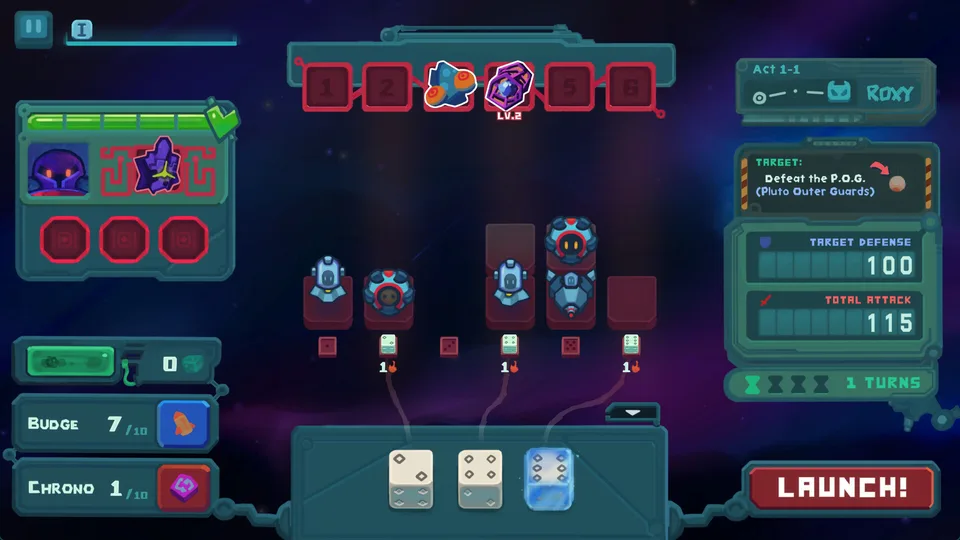
At its heart, the game is a grid-based roguelike where your success depends on how you position units and manipulate dice outcomes. Unlike many other deckbuilders where units fight automatically, this game requires you to be the tactical architect of your invasion force.
Each column on your grid corresponds to a specific number on your dice. When you roll, the result dictates which columns activate. Your goal is to reach a target damage threshold within four turns. If you fail to meet the damage requirement, your force loses health, slowly leading to a game over.
Phase
Action
Purpose
Drafting
Place units in columns
Sets the base strength for potential rolls
Rolling
Roll three dice
Determines which columns fire and their multipliers
Management
Spend Budge/Chrono
Adjusts dice results to hit target columns
Cleanup
Sacrifice/Upgrade
Prepares the grid for the next turn
The Strategic Importance of 'Budge' and 'Chrono'
One of the most common mistakes players make is hoarding resources. In Dicevaders, 'Budge' and 'Chrono' are your best friends. Budge allows you to nudge a dice roll up or down by one, giving you the precision needed to land on high-value units. Chrono, on the other hand, lets you re-roll entirely when the odds are stacked against you.
According to recent community reports, the most successful players treat these currencies as active tools rather than emergency reserves. By spending them early to ensure you hit your damage targets, you gain more cash, which in turn allows you to buy more powerful artifacts and units.
Tip
Resource Management Priority
Always prioritize spending Budge to secure a high-multiplier turn rather than saving it for a "perfect" roll that may never come.
Unit Synergy: Building Your Invasion Force
Managing your units is not just about raw strength; it is about placement and ability synergy. Some units possess unique traits, such as teleporting between turns, attacking multiple times, or triggering adjacent units.
A highly effective strategy involves sacrificing weaker units to bolster the strength of a "carry" unit. For instance, if you have a unit that hits six times in the sixth column, feeding it the strength stats of a redundant unit can turn a mediocre turn into a million-damage powerhouse.
Essential Unit Types and Their Roles
Multiplier Units: Best placed in high-traffic columns to maximize base damage.
Support/Swarmers: Share strength stats with neighbors; ideal for creating a consistent damage floor.
Teleporters: Offer flexibility in positioning, allowing you to react to changing board states.
Avoiding Common Pitfalls
Even experienced players often fall into the trap of over-relying on a single strategy. If you build your entire run around one type of unit, a bad roll or a specific artifact scarcity can end your game abruptly. The game is designed to punish tunnel vision.
Instead, keep your strategy fluid. If the shop offers an artifact that scales with a different unit type, be willing to pivot. The game provides enough depth that you can usually find a way to make your current build work by adjusting your positioning or artifact loadout.
Pitfall
Consequence
How to Fix
Tunnel Vision
Vulnerable to RNG
Diversify your unit types
Hoarding Currencies
Dying with resources
Spend Budge to hit targets early
Ignoring Sacrifices
Low unit strength
Feed weaker units to your main attackers
Why Dicevaders Stays Fresh
The replayability of this title comes from its sheer number of unit variants and artifact combinations. You can read more about the developer’s vision and latest updates on the official Dicevaders Steam Page.
The game does an excellent job of teaching you the ropes through simple tutorials, but the skill ceiling is remarkably high. As you progress, you will find yourself calculating damage numbers in your head, trying to optimize your grid for that one perfect, massive-damage turn. It is this "just one more run" feeling that makes the game a standout in the 2026 gaming landscape.
Frequently Asked Questions (FAQ)
What is the main goal in Dicevaders?
The primary goal is to hit a specific damage target across four turns. If you fail, you lose health until you are defeated. Mastering Dicevaders requires balancing your unit placement with careful resource management.
How do I increase my damage output?
Focus on unit synergy and artifact stacking. By sacrificing units to boost the strength of your strongest cards and using Budge to manipulate dice into your best columns, you can reach millions in damage.
Is the game purely based on luck?
While rolling dice involves chance, the game provides significant agency through Budge and Chrono. These tools allow you to mitigate bad luck, making the experience feel fair and skill-based rather than purely random.
Can I play this on the go?
Yes, the game is well-suited for handheld devices like the Steam Deck. Players report that it is the perfect "quick run" game for short sessions, making it highly accessible for busy schedules.